Listen to this article
The first thing most visitors notice about Rosh Hashanah is the noise.
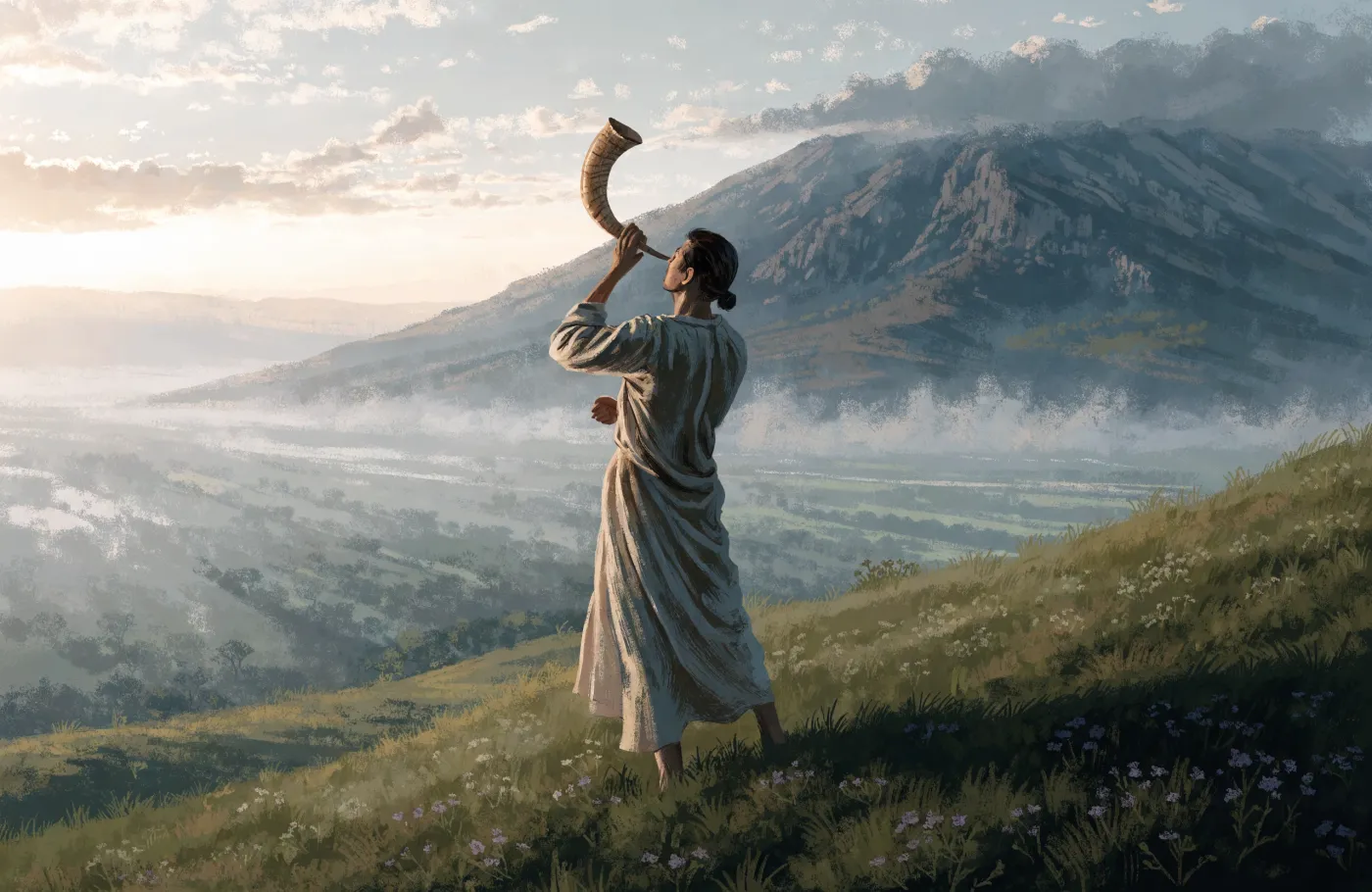
It is not a pleasant noise. A shofar is a ram's horn, hollowed out and bored through at the narrow end, and it is played by a person rather than a machine — which means it cracks, it wavers, and it sometimes fails outright on the first attempt. Nobody is embarrassed when it does. That turns out to be part of the point.
Scripture does not call the day Rosh Hashanah. It calls it Yom Teruah, the day of blowing. Leviticus gives it in a single line: a day of rest, a memorial announced with the blast of horns, a holy gathering. No reason is attached. The command arrives with no explanation at all, which has left about three thousand years of people asking the obvious question.
The sound before the sound
Israel had heard a shofar once already. At Sinai the mountain is wrapped in smoke and there is a horn sounding, and Exodus says something strange about it: the sound grew louder and louder. Not fainter, the way sound behaves. Louder. The people standing at the foot of the mountain trembled.
So when the horn is blown on Yom Teruah, it is not introducing anything new. It is recalling something. The congregation is being put back at the foot of a mountain, in front of a God who speaks.
A shofar is not an instrument you play well. It is one that exposes whether you have any breath left.
Four sounds, and their shape
There are traditionally four:
- Tekiah — one long, unbroken note.
- Shevarim — three broken notes, like a sigh.
- Teruah — nine short blasts, quick and urgent.
- Tekiah gedolah — the long one at the end, held as long as the lungs allow.
Heard in order they are a shape rather than a fanfare: something whole, something broken, something frantic, and then something whole again and held. People have been finding their own year inside that sequence for a very long time.
The oldest good answer
The best short answer to why is nearly nine hundred years old. Writing on the laws of repentance, Maimonides said the horn is a wake-up call, and put words in its mouth: Awake, you sleepers, from your sleep.
That is not a remark about mornings. His point is that a person can go a long way asleep — keep a schedule, hold a job, attend a synagogue every week — and still not have looked honestly at their own life in years. The horn interrupts. It is deliberately not beautiful, because beautiful things are easy to sit through.
And the ten days after
Yom Teruah does not stand on its own. It opens ten days that close at Yom Kippur — this year on the evening of September 20 and the morning of September 21. Those days are given to the unglamorous work: the apology you have been putting off, the debt you have not mentioned, the relationship you allowed to go quiet. The horn is the starting gun for that. It is not the event.
Why we still blow it
We are a Messianic congregation, so the sound carries one thing more.
The New Testament does not treat the shofar as a piece of the past. Paul writes to Corinth about the last trumpet, and to Thessalonica that the Lord Himself will come down with the trumpet of God. Whatever else that means, it means the sound is not only backward-looking. The horn that recalls Sinai is also listening for a morning nobody has heard yet.
So we blow it. Badly, some years. In a room on East 61st Street, with the traffic outside carrying on exactly as before.
Come and see for yourself
Shabbat Night is Friday at 7:00 PM and Shabbat Morning is Saturday at 11:00 AM, in person at 250 E 61st St, New York, NY 10065. No registration, and nothing you need to know beforehand — everything is explained as we go.
Keep Reading