Listen to this article
Ki Teitzei carries more commandments than any other portion in the Torah — seventy-four of them by the traditional count, arriving one after another with barely a breath in between. Runaway slaves, lost property, roof railings, fair weights, the treatment of prisoners and of birds' nests. It reads less like a sermon than like somebody emptying their pockets onto a table.
And then, near the end, a law about being forgetful.
The law
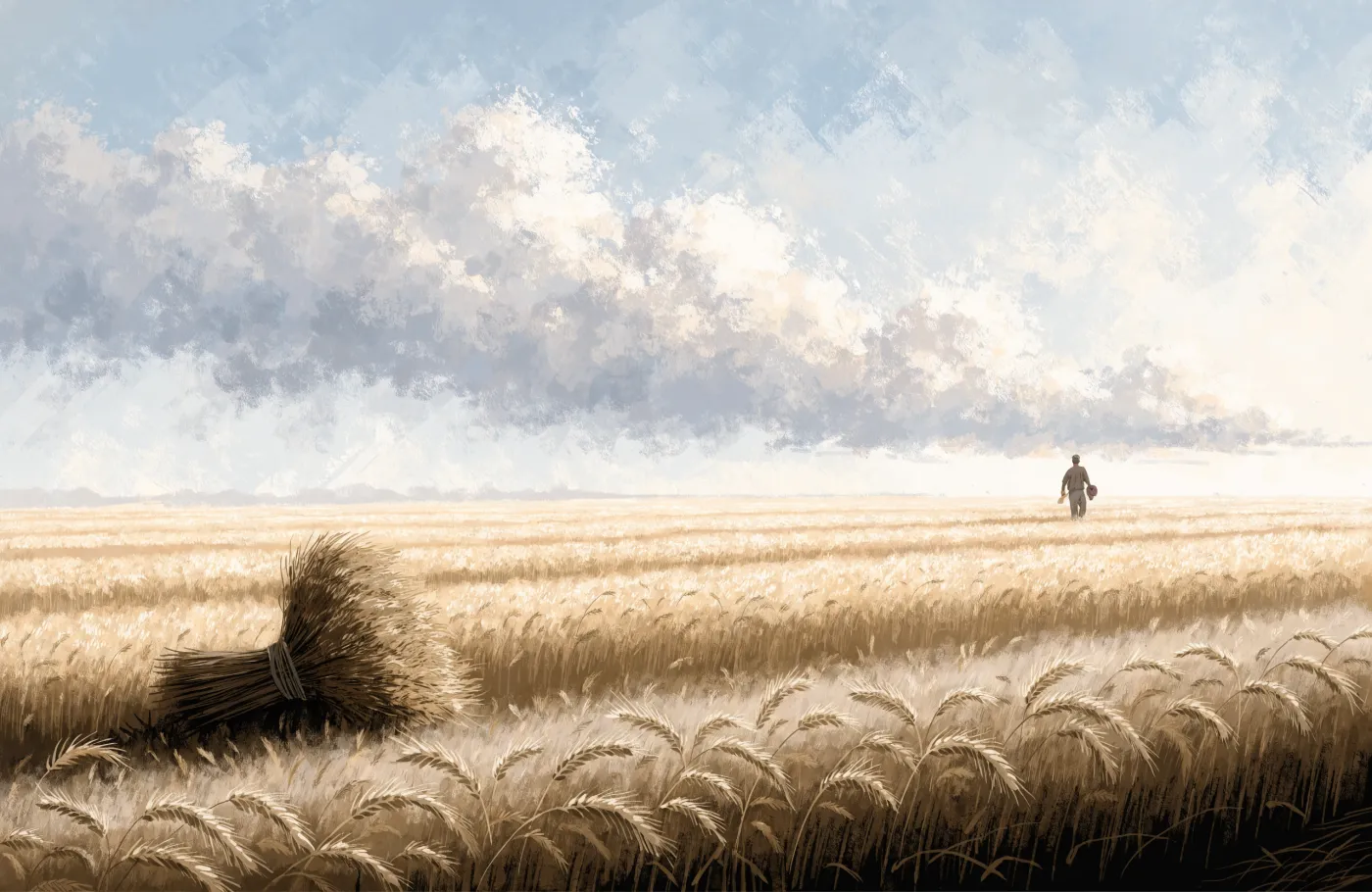
When you reap your harvest in your field, and forget a sheaf in the field, you are not to go back and get it. Leave it for the stranger, the orphan and the widow.
Read that again, because it is stranger than it first appears. This is not a command to give. It is a command about what to do once you have already failed to be thorough. The sheaf is not set aside on purpose. It is left because somebody was tired, or careless, or working too fast in the heat, and it slipped their mind.
The Torah does not tell you to be more careful. It tells you to walk away.
The command is not "be generous." It is "do not go back."
Harvesting badly on purpose
Alongside this sit the other gleaning laws: do not reap to the very edges of the field, do not strip the vine bare, do not go over the olive tree a second time. Taken together they describe a way of farming that is deliberately inefficient. You are being told, in plain agricultural terms, to leave money in the ground.
The reason given is not economics and not sentiment. It is memory. You were a slave in Egypt, the text says, and that is why. A person who remembers being on the outside of somebody else's abundance farms differently.
Why it is not charity
There is no giver in this arrangement, and that is the point. The widow gathering at the edge of the field is not receiving a gift from a landowner who has decided she is deserving. She is collecting what is already hers by law. Nobody has to be grateful and nobody gets to feel generous.
That is a more dignified arrangement than most of what we have built since. It also explains why the Book of Ruth can open the way it does, with a Moabite woman gleaning in a field near Bethlehem — not begging, not pleading, simply exercising a right the Torah had already written down for her. The whole of that story, and the line that runs from it, rests on a law about forgotten sheaves.
What to do with it
The literal application is easy enough to see and hard to live. Most of us are not farmers, but almost everyone has edges: margins we could work harder, gaps we could close, things we could go back for. This portion says that some of those gaps are meant to stay open, and that the person who finds something in them owes us nothing.
The harder application is the one about failure. You will forget things. The Torah assumes it, builds a law around it, and turns the oversight into somebody else's provision. Not every mistake has to be corrected. Some of them, left alone, become the way a stranger eats.
This week
Ki Teitzei covers Deuteronomy 21:10 to 25:19, and the haftarah is Isaiah 54:1-10 — a passage about a woman who thought she had been abandoned and had not been. Synagogues around the world are reading the same portion on the same Shabbat, as they have for centuries.
We read it Saturday morning at eleven, in Hebrew and in English, and then we talk about it.
Come and see for yourself
Shabbat Night is Friday at 7:00 PM and Shabbat Morning is Saturday at 11:00 AM, in person at 250 E 61st St, New York, NY 10065. No registration, and nothing you need to know beforehand — everything is explained as we go.
Keep Reading